Sowing Generosity
Sowing Generosity
Matt 13:1-9, 18-23 NLT
Later that same day Jesus left the house and sat beside the lake. A large crowd soon gathered around him, so he got into a boat. Then he sat there and taught as the people stood on the shore. He told many stories in the form of parables, such as this one:
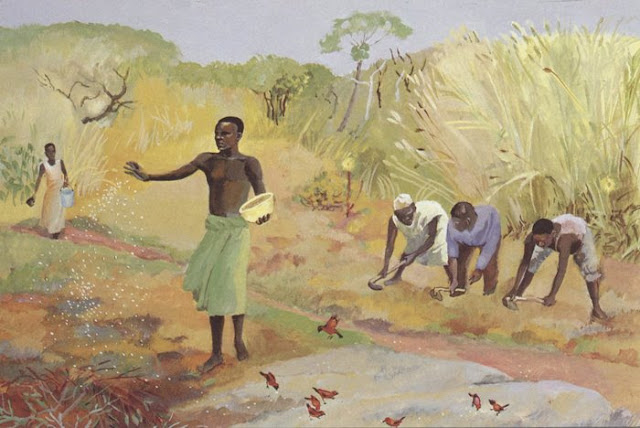
“Listen! A farmer went out to plant some seeds. As he scattered them across his field, some seeds fell on a footpath, and the birds came and ate them. Other seeds fell on shallow soil with underlying rock. The seeds sprouted quickly because the soil was shallow. But the plants soon wilted under the hot sun, and since they didn’t have deep roots, they died. Other seeds fell among thorns that grew up and choked out the tender plants. Still other seeds fell on fertile soil, and they produced a crop that was thirty, sixty, and even a hundred times as much as had been planted! Anyone with ears to hear should listen and understand.”
…
“Now listen to the explanation of the parable about the farmer planting seeds: The seed that fell on the footpath represents those who hear the message about the Kingdom and don’t understand it. Then the evil one comes and snatches away the seed that was planted in their hearts. The seed on the rocky soil represents those who hear the message and immediately receive it with joy. But since they don’t have deep roots, they don’t last long. They fall away as soon as they have problems or are persecuted for believing God’s word. The seed that fell among the thorns represents those who hear God’s word, but all too quickly the message is crowded out by the worries of this life and the lure of wealth, so no fruit is produced. The seed that fell on good soil represents those who truly hear and understand God’s word and produce a harvest of thirty, sixty, or even a hundred times as much as had been planted!
Jesus is a great storyteller and a great teacher. He teaches using ordinary images. Instead of focusing on big dramatic events and instead of reducing his teaching to systems or principles, Jesus uses everyday things you could encounter in almost any society, images anybody across history can identify with.
And these stories taken from ordinary life often aren’t about what they seem to be about. This story seems to be about farming, but Jesus isn’t teaching us about farming; he’s helping us get to know his Heavenly Father. We can try to figure out farming through observation and trial and error and passing down wisdom from the old to the young, but you can’t get to know a person by running experiments on them. And you can’t get to know a person through rumors and word of mouth from people who don’t know that person themselves. Jesus tells us that he is the only one who knows his Father.
“__My Father has entrusted everything to me. No one truly knows the Son except the Father, and no one truly knows the Father except the Son and those to whom the Son chooses to reveal him.” – Matt 11:27
Getting to know our heavenly Father is essential. It’s essential for each of us because it’s in coming to know your Father that you come to know yourself. It’s in coming to know God as our Heavenly Father that we who feel lost learn to come home to him.
So here’s a story about a farmer sowing seed. It’s a simple story and you can picture it. A farmer walks down a path to his field with a sack of seeds hanging from his shoulder. His job is simple: get seeds into the ground when the time is right so they can sprout and grow and all goes well, come harvest he’ll celebrate bringing in what his field has produced.
But the way this farmer sows his seed isn’t the way we do. Nowadays if you farm land, you use a tractor and you calibrate the tractor to the crop you’re trying to sow and grow. You might have a seed drill that operates every few inches and drops a single seed into a hole that’s just the right size and just the right depth.
This farmer is broadcasting. He’s spreading seed all over the plowed field, but he’s spreading seed lots of other places too. Sometimes the birds eat his seed. Sometimes it falls on rocky ground. Sometimes it falls among thorns.
And Jesus tells his disciples that the way the soil responds to the seed is like the way we respond to the good news of the Kingdom of Heaven. He uses three examples: hungry birds, stony ground and crowding thorns. When God declares good news, sometimes it seems like pests carry away our joy. Sometimes there’s enthusiasm that doesn’t last. Sometimes there’s competition that interferes with our growth.
Maybe you’ve seen that happen in your life or in somebody else’s. Maybe you’ve seen life-giving, love-filled good news that didn’t make much of a difference because it never found a receptive heart; something resisted it or carried it away. Maybe there has been spiritual shallowness, or so many distractions that any joyful response to good news gets tangled up with competing concerns.
Here’s where I am supposed to tell you that you need to change what kind of ground you are. You should get off your butt and drive away those hungry birds that keep stealing the joy of the Kingdom. You should grab a shovel and start to dig up the stones that cause your new growth to dry up and die. You should put on some gloves and get to work weeding out all the thorns that interfere with your participation in God’s Kingdom.
But I’m not going to tell you that because Jesus doesn’t tell us that.
Jesus isn’t telling us to clean ourselves up and through our own effort become more receptive. He isn’t telling us to become better ground so the seed he’s sowing will take root and grow healthy and strong.
Jesus is encouraging his disciples. The good news is so good! In Jesus God has entered our world as one of us. You and I have been so confused about who we are, so confused about what we’re due, so ungrounded in our present and uncertain about our future. But Jesus, the Son of God, shares his sonship with us; he reveals that we can know God as our Heavenly Father, the one who loves us and has always loved us, the one who loves humanity and every human, the one who is the source of all joy and love and life. The only reason we know love at all is because of his love. The only life we have comes from his life. And God has not been content to be an absent Father we only know through rumors and hearsay; he comes to be at home with us, to fill us with himself. And that kind of God, that kind of King, is now ruling and drawing all of us into a Kingdom that is founded and powered by this kind of love.
Now we have hope. Now we can receive real and revolutionary love. Now we can live together as beloved children of an ever-present Father who is always for us.
So his disciples are absolutely perplexed. They’re at their wits’ end, because they are all in. They know how good this news is, but not everybody gets it! Not everybody is as enthusiastic about this good news as they are. Or sometimes they are, and then the enthusiasm fizzles. Sometimes the good news gets crowded out by so much bad news. Sometimes people just come for the stories, and miss what they’re really about.
But the farmer keeps sowing his seed. He doesn’t carry a seed drill. He isn’t trying to achieve maximum efficiency. No, he keeps on giving. He never stops giving. And he knows that just as in our own lives when you and I sometimes have not been so receptive; when you and I sometimes have exploded in enthusiasm only to quickly move on; when you and I sometimes have gotten lost in our distractions; just as God has never given up on us, the disciples can be encouraged that they never need to give up. Maybe today sharing the good news seems fruitless. But those same people who don’t seem receptive today might realize what the stories are really about tomorrow, because these are seasons we find ourselves in. God never stops giving. His giving doesn’t depend on how we respond.
The good news is also that Jesus has responded where we couldn’t. You and I have trouble believing that the Good News can be this good, that God can be this gracious, that our Heavenly Father will want to be around us given all we’ve done and all we’ve gone through. Jesus knows what that is like. He knows how hard it can be. And at the same time Jesus has always been at home with his Heavenly Father, and he’ll always be at home with us. Jesus believes and receives and lives in his Father’s love, and he shares that life of assurance and fullness with you and with me. We can enjoy his faith and his life. We can have hope for ourselves and for our world because Jesus hopes and trusts for us.
And we know he has never given up on us. He never stops giving. Jesus gives till it hurts; Jesus gives to the very end. He gives his very life for our sake in his determination that we will spend eternity together in love. The only future God wants for us is the future where we are all celebrating together, safe in our Father’s arms, growing in our belonging, welcome and joining him at his table.
BENEDICTION
The LORD bless you and keep you; the LORD make his face shine on you and be gracious to you; the LORD turn his face toward you and give you peace.